

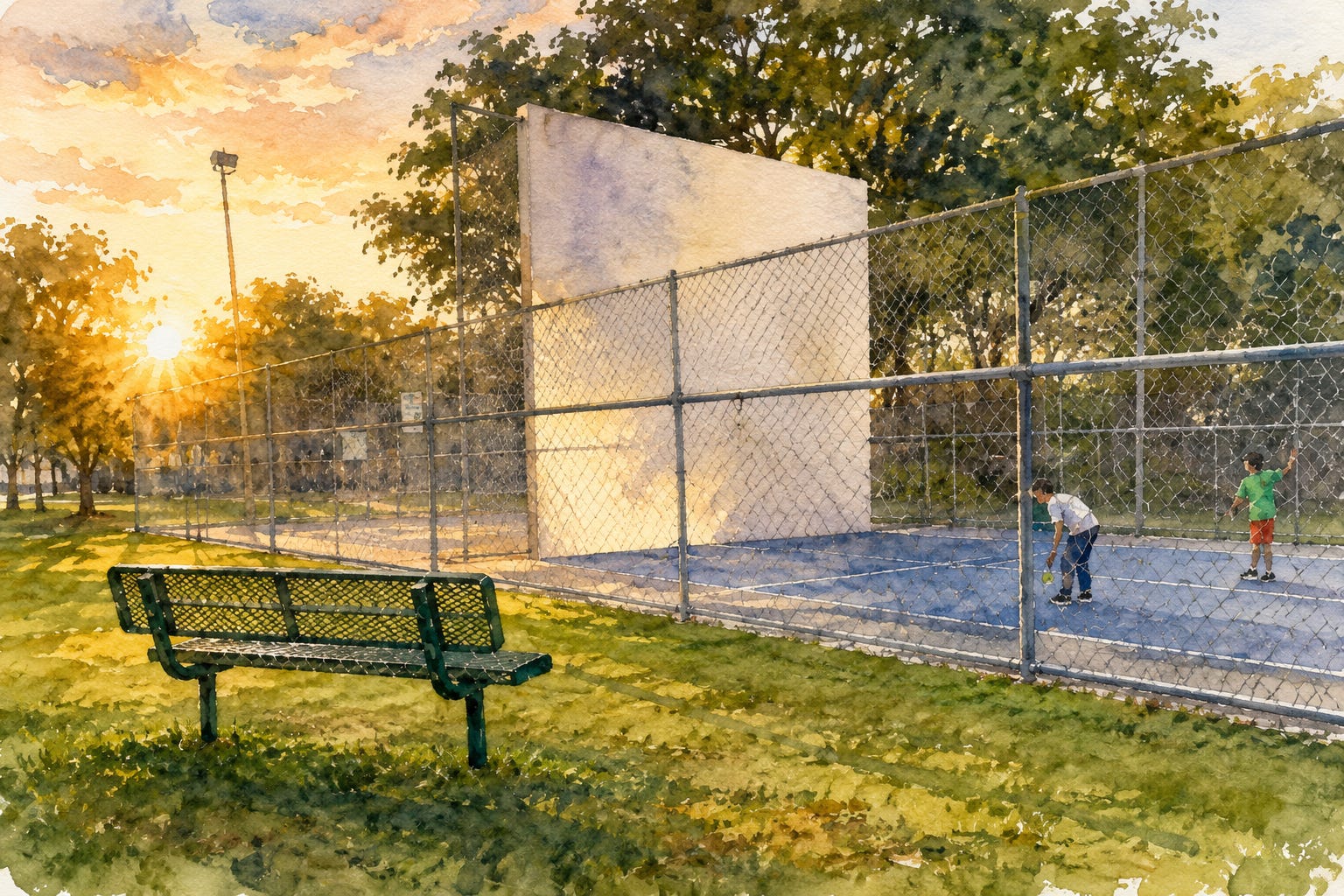
During COVID, I kept seeing the same woman at the tennis courts.
She wasn’t playing matches.
She wasn’t taking lessons.
She wasn’t part of a group.
She was standing alone hitting tennis balls against a wall.
For hours.
Day after day.
At some point I walked over and invited her to one of my classes.
She showed up.
A few months later she met a man in that group.
Years later he proposed on the same court where they met.
I attended their wedding in Mexico.
Today they’re expecting a baby.
Nobody gets married because of a better backhand.
For years I told that story as a tennis story.
Now I think it’s about something else entirely.
It forced me to ask a question I had somehow avoided for most of my career:
What business was I actually in?
Not what did I sell.
What did people actually buy?
A few weeks ago I spent an evening reading old Google reviews from Backhand City.
I expected comments about coaching.
Better serves.
Better volleys.
Better footwork.
Instead I found something else.
One player thanked me for understanding how they learned.
Another talked about meeting friends through class and spending time with them outside of tennis.
Another mentioned being connected with the right group.
Another described going from complete beginner to confident competitor.
The details were different.
The message wasn’t.
Every review was saying the same thing.
I just wasn’t reading them closely enough.
People weren’t thanking me for tennis.
They were thanking me for recognition.
At first that sounded too simple.
Then I started thinking about the people who changed my own life.
A teacher.
A coach.
A mentor.
A friend.
None of them handed me a new identity.
They simply saw one before I did.
Recognition is one of those things you don’t think about until it’s missing.
Most people can remember the teacher who believed in them.
The coach who gave them confidence.
The boss who gave them a chance.
The friend who invited them into a group.
Not because those people gave them information.
Because those people made them visible.
I think we’ve misunderstood community.
Community isn’t the starting point.
Recognition is.
Before people join a community, someone usually notices them.
Invites them.
Welcomes them.
Remembers their name.
Makes room for them.
Community comes later.
Recognition comes first.
Community is what happens after recognition.
That’s why I think loneliness is often misunderstood.
Most people assume lonely people need more people.
I’m not sure that’s true.
I think they need more recognition.
People know their name.
Nobody knows them.
That’s a different problem.
For years researchers have documented the decline of civic life.
Fewer clubs.
Fewer organizations.
Fewer places where people gather.
Robert Putnam famously called it Bowling Alone.
His diagnosis made sense.
Americans were becoming disconnected.
Then Mark Zuckerberg happened.
The internet didn’t eliminate participation.
It moved it.
Today we belong to Facebook groups, Slack channels, Discord servers, group texts, Reddit communities, and countless digital networks.
We’re connected to more people than Putnam could have imagined.
And yet loneliness remains stubbornly high.
That’s the puzzle.
The data backs up what most people already feel. In 2023, the U.S. Surgeon General called loneliness and isolation a public health epidemic. A 2024 American Psychiatric Association poll found that nearly one in three American adults felt lonely at least once a week. Harvard’s Making Caring Common project found that more than one in five U.S. adults feel lonely.
So the question is not whether loneliness is real.
The question is whether we understand what people are actually missing.
If connection was the cure, we should be thriving.
Instead many people feel invisible while connected to everyone.
I think Putnam identified the symptom.
Recognition identifies the mechanism.
The last twenty-five years taught us something important.
Connection and recognition are not the same thing.
The internet scaled visibility.
It didn’t scale recognition.
Visibility says:
I can see you.
Recognition says:
I understand you.
Visibility says:
I know your name.
Recognition says:
I know your story.
Visibility says:
You appeared in my feed.
Recognition says:
You matter to me.
That’s why loneliness isn’t simply the absence of people.
It’s the absence of recognition.
A person can have five close friends and feel deeply known.
Another can have fifty thousand followers and feel completely invisible.
The variable isn’t connection.
It’s recognition.
People rarely accept guidance from someone who hasn’t first recognized them.
A coach.
A teacher.
A mentor.
A friend.
A writer.
The order matters.
Recognition first.
Advice second.
Stephen Covey built an entire habit around this idea in The 7 Habits of Highly Effective People: “Seek first to understand, then to be understood.”
That may be the deepest rule in coaching, teaching, friendship, and leadership.
People don’t change when they are given information.
They change when they feel understood.
Maybe that’s why certain teachers stay with us for decades.
Maybe that’s why some coaches change lives while others simply teach skills.
Maybe that’s why millions of people listened to Jordan Peterson.
Not because he gave them new rules.
Most of the rules were old.
Responsibility.
Discipline.
Meaning.
Purpose.
What was new was the feeling that someone finally understood what they were struggling with.
Recognition came first.
The advice landed second.
Looking back, I spent years saying I was building community.
I don’t think that’s what I was doing.
I was helping people become visible.
The woman hitting tennis balls alone against a wall wasn’t looking for a community.
She probably wasn’t looking for a husband either.
She was looking for a place where she belonged.
The invitation came first.
Everything else happened after.