

“Build a product so good you can describe it in one sentence—and your customers want to tell all their friends about it.”
— Sam Altman
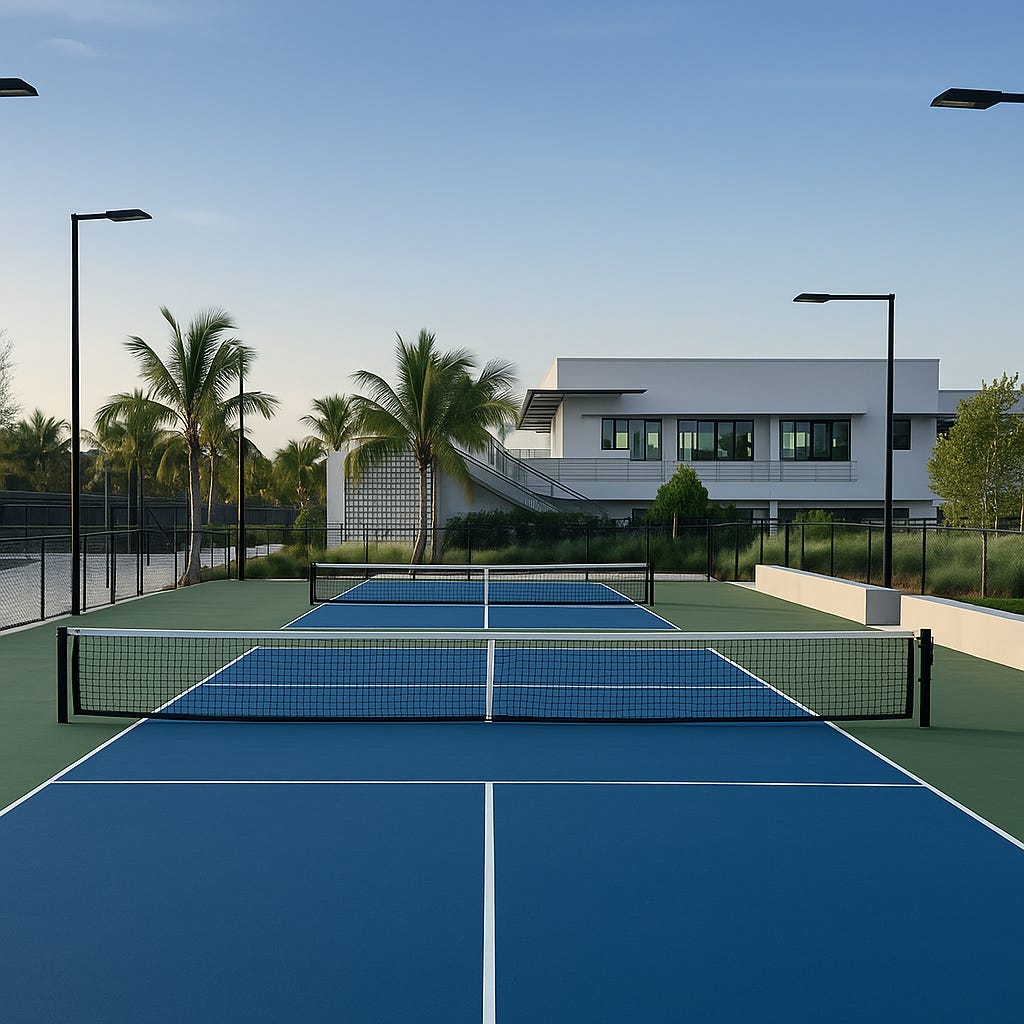
Pickleball hasn’t figured that out yet.
Across South Florida, developers are pouring concrete faster than they’re building conviction. New facilities rise with the confidence of a gold rush—steel roofs, LED lights, launch parties, hashtags. The product is beautiful, but the proposition is blurry.
Ask ten owners what business they’re in and you’ll hear ten different answers: a social club, a wellness brand, a sports academy, a real-estate play, a franchise prototype, a “community hub.” None of them are wrong, but almost all are unfocused. The result is an industry booming in participation yet fragile in profit—full of passion, projection, and missed fundamentals.
Florida is the case study. The demographics are perfect, the weather ideal, the demand bottomless. Yet margins are thin, turnover high, and the failure rate rising. From Boca Paddle to Lake Wood Ranch to The Fort, the pattern repeats: the concrete goes down easy; the business falls apart slowly.
Altman’s sentence haunts this landscape because no one in the racquet-sports world seems able to write theirs. What’s your one-line product? A lifestyle? A lesson? A league? A luxury experience? Until that’s clear, every pickleball venture risks becoming another expensive hobby that looks like a company.
This essay is for the insiders—the pros, the operators, the investors—who feel the dissonance between the hype and the spreadsheets. It’s a look beneath the champagne toasts and press releases at the five truths shaping the real economics of the sport.
1. The Business-Model Identity Crisis
The question that quietly haunts every pickleball operator is simple: What business are you actually in?
Most can’t answer without hesitation.
Some say fitness. Others say hospitality. A few call it community. Many still think it’s real estate.
This confusion is the industry’s original sin—and the reason so many courts gleam while balance sheets wilt.
Equinox or Planet Fitness?
At one end of the spectrum are the boutique social clubs—think Equinox with paddles. Climate-controlled courts, F&B lounges, branded apparel. Memberships hover around $300–$400 a month, initiation fees extra. The product is lifestyle, not sport.
At the other end are access clubs—the Planet Fitness model—high-volume, low-price, no frills. CourtReserve handles scheduling, there’s a cooler of Gatorade by the fence, and the goal is throughput.
Both models can work. The problem is when clubs try to be both.
They build like Equinox but charge like Planet Fitness, hoping that “volume” will close the gap. It doesn’t. Not in a state where playable hours cap at 8 a.m.–11 a.m. and 5 p.m.–9 p.m., and even the most loyal members disappear during hurricane season.
The Lake Wood Ranch Lesson
At Lake Wood Ranch, the pros eventually got bored—hitting endless dinks and “around-the-post” trick shots for seniors chasing highlight-reel fantasies on fixed budgets.
The coaches were craftsmen. The owners were financiers. The players were hobbyists. No one shared a definition of success.
When that happens, no amount of marketing saves you.
Because in racquet sports, coaches make the business go.
The Investor’s Projection Trap
Most investors made their money elsewhere. They repurpose that mindset—believing if they pour enough capital into construction, programming will appear. But pickleball isn’t SaaS; it’s human. You can’t A/B-test community.
The clubs that last are the ones that build inside-out:
start with coaches → build community → monetize experience.
Outside-in looks exciting but burns capital faster than sunlight on hardcourt acrylic.
If you can’t describe your club in one sentence, you don’t have a business model—you have décor.
2. The Fly-by-Night Factor
Pickleball has never lacked enthusiasm. What it lacks is staying power.
Every month another “academy,” “collective,” or “club concept” launches with a glossy logo and a short runway. Within a year, half are rebranded or gone.
The Transient Ecosystem
Racquet sports are personality-driven and transactional. Tennis survived because country clubs subsidized it. Pickleball is running a start-up experiment with no institutional backbone, no credentialing, and no shared economics.
Anyone with $3 K and a drone can become a “pro.” Anyone with a lease can call themselves a “club.” The bar for entry is low; the bar for excellence is high.
Best chatbot.
Designed pickleball players who have more questions than answers.
The People Problem
Ask any operator: coaches make the business go.
But they’re also the first to burn out.
Pros don’t just want to teach; they want to progress. When their ceiling stalls, they leave—and when they leave, retention follows them out the gate.
Investor Psychology
The money often comes from real-estate or finance veterans projecting their mindset onto a relationship business. They hold pep rallies instead of building systems.
Passion is cheap. Payroll isn’t.
Without career pathways, benefits, or professional standards, turnover becomes structural. Each rebrand resets trust.
And because almost no one is building internally out—focusing on coaching pipelines, staff training, member trust—the industry remains a carousel of restarts.
Continuity, not capital, is the real moat.
3. Napkin Economics: It’s Easier to Build the Real Estate than the Business
Every pickleball dream starts with a napkin sketch: “All we need is twelve courts and a bar.”
The numbers always fit neatly on paper. The costs don’t.
You can finance concrete.
You can’t finance culture.
Developers vs. Operators
Developers see efficiency; operators see volatility.
The spreadsheet says “break-even in 24 months.” The staff knows it rains 90 days a year.
Florida amplifies the risk: expensive land, limited playable hours, rising labor costs. Indoor or covered space solves heat but multiplies cost.
Inflation: The Silent Partner
Fort Lauderdale’s $200 million park plan still sits half-built, strangled by cost escalation.
Apply that to private clubs: a $7.5 million covered-court project in 2023 quietly becomes $8.6 million by 2025—before a single membership swipe.
Time, in this business, is the most expensive opponent on the court.
The Hidden Line Item
Human energy doesn’t appear on a P&L.
At Lake Wood Ranch it wasn’t the structure that failed; it was the spirit. Pros lost enthusiasm, members drifted, ownership misread it as a marketing issue. But you can’t market your way out of morale.
Every disengaged hour is a silent write-off.
The Math That Matters
On paper, a $9 million facility earning $1.8 million looks strong.
After expenses, it’s break-even.
Add a 10 % franchise or influencer cut—and you’re underwater.
Utilization × Retention × Pricing Discipline = Survival.
Everything else is noise.
4. The Third-Party Mirage: Influencers, Partnerships & the Groupon Trap
The next trap begins when someone says, “We just need more visibility.”
Enter the influencer, the agency, the daily-deal site.
The Seduction of Exposure
South Florida is the epicenter. Every club wants drone footage, hashtags, a celebrity cameo. It feels like progress—and it works, briefly.
Influencers bring traffic, not loyalty. When the discount ends, the dopamine does too.
You can’t pay your coaches with exposure.
The Groupon Effect
Set the first price too low and you’ll never recover.
Ten “free-play nights” at $10 a head trains customers to expect it forever.
Meanwhile, public facilities like Patch Reef Park’s 18 covered courts offer low cost access. Competing on price is a race to the bottom.
Ten free hours a week at $100/hour is $52 K a year in lost revenue—the salary of a full-time coach.
Why Clubs Keep Doing It
Because marketing feels like momentum. Likes feel like loyalty.
But sustainable growth comes from relationships, not reach.
The best advertising in pickleball is a satisfied doubles partner.
A Smarter Partnership Play
Florida’s best operators are pivoting to:
Local league partnerships over influencer nights.
Micro-creators paid on conversion.
Charity events that create goodwill instead of giveaways.
The difference between a gimmick and a growth engine is measurement.
5. The Franchise Fallacy: Brand, Passion, or Business?
Franchising was supposed to be pickleball’s safety net. Instead, it’s become the industry’s most expensive form of optimism.
The Pitch vs. The Math
Franchises sell comfort: a system, a logo, a playbook.
But that 10 % royalty on $1.5 million revenue is $150 K a year—in a business where margins hover near 15 %.
If the brand doesn’t add at least as much value as it extracts, it’s not a franchise—it’s a tax.
Passion Projects in Corporate Clothing
Most “national brands” are still prototypes. They look like systems but run like start-ups. Expansion before cohesion; hype before habit.
They’re still building externally inward, chasing scale before substance.
The Control Paradox
Franchises promise structure but demand obedience.
They can’t adapt to Florida’s heat, Boca’s retiree hours, or hurricane downtime.
And members don’t join brands—they join people.
You can license a logo.
You can’t franchise belonging.
The Path Forward
Franchising could work—if it flips the pyramid:
Shared tech, not rigid templates.
Tournament networks that justify royalties.
Fees tied to profit, not gross.
Until then, franchises replicate the same external-inward mistakes, only faster.
Epilogue: Building from the Inside Out
Pickleball has heart. The effort is everywhere—coaches grinding, members organizing, investors dreaming. The sport hums with goodwill.
What’s missing isn’t enthusiasm. It’s alignment.
Operators face a paradox: paying coaches more increases success odds, but the real challenge is finding the right people—those who can build community from the inside out.
Not every great instructor is a builder of culture. Not every investor knows how to empower one.
The future of this industry belongs to pros who teach and lead, to managers who measure culture as carefully as revenue, and to investors who understand that attention and belonging are different currencies.
You can finance concrete, but you can’t finance culture.
When clubs start there—when they build from the inside out—they stop chasing customers and start creating citizens.
And that’s when the game finally becomes a business.
Author Note
Brian Lutz is a racquets professional, writer, and operator based in South Florida. He’s coached, built, and occasionally rebuilt programs across S. Florida—from private clubs to public partnerships. His essays on sport, business, and mindset appear weekly on Brian Thinks —a publication exploring the art and science of building community through play.