
What You Expect… and What Actually Happens
A night at the public courts where the game revealed something else entirely.

“A capacity for surprise is an essential aspect of our mental life, and surprise itself is the most sensitive indication of how we understand our world and what we expect from it.”
— Daniel Kahneman
Tonight wasn’t really about pickleball.
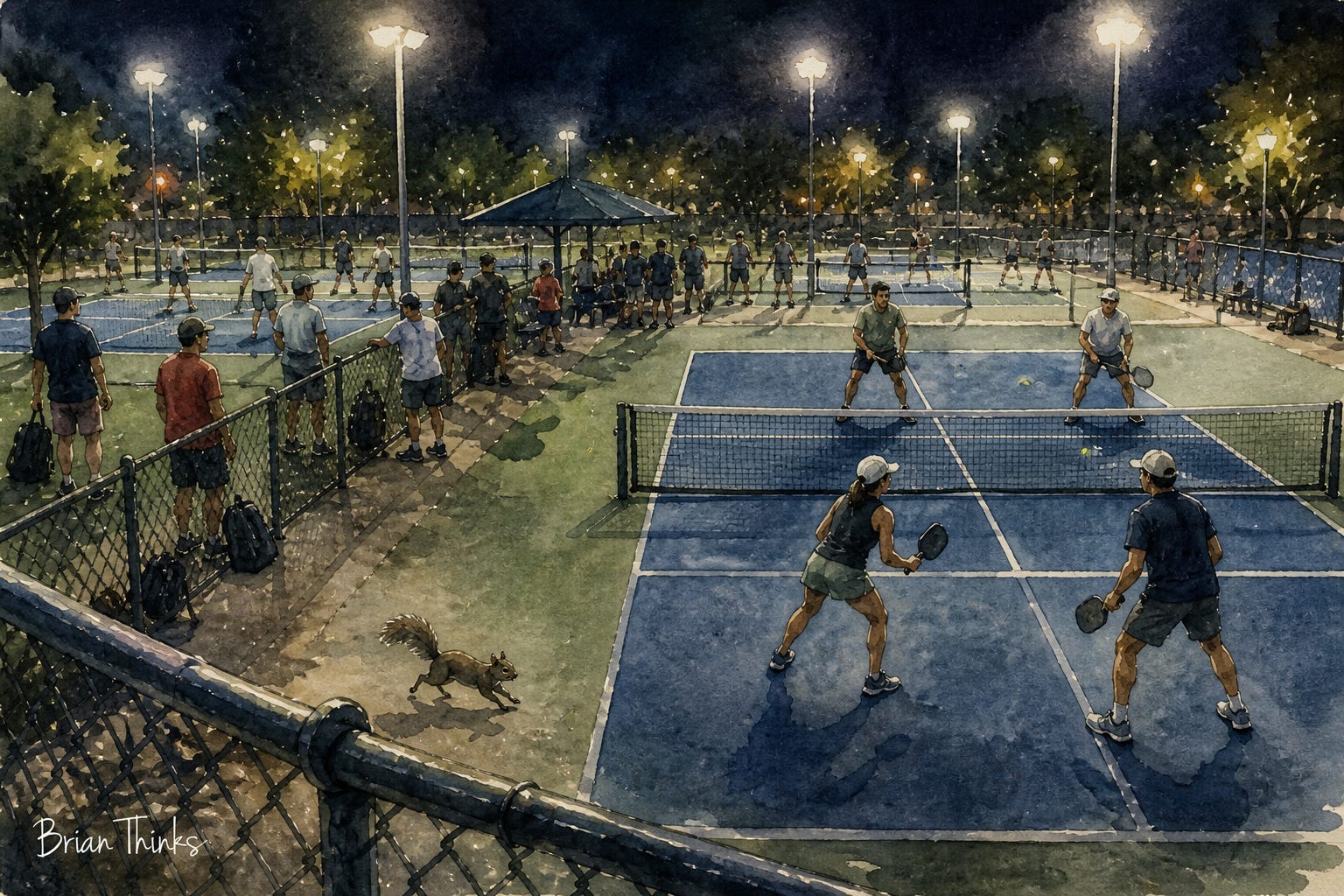
It looked like pickleball. Sounded like pickleball. Four people on a court. Paddles popping under LED lights. Balls rolling under fences. Music leaking from somebody’s Bluetooth speaker. Open play chaos. The usual South Florida park energy.
At one point, a squirrel ran directly across the middle of the court during a rally like it had court priority.
Nobody even reacted for a second.
That’s how chaotic public pickleball parks are becoming.
And honestly, the squirrel fit right in.
Because tonight wasn’t really about pickleball.
It was about people handling pressure in public.
I went to the courts mostly to test technology. I wanted to see if I could quietly stream live court action on Kick using only my phone and a simple mobile setup. No production crew. No giant tripod. No overthinking. Just atmosphere. Real life. A sandbox.
The stream itself barely mattered.
What mattered was what started revealing itself once I stopped thinking like a coach and started observing like a documentarian.
Public courts are different from country clubs. Not better. Not worse. Just less filtered.
At a club, people usually arrive already socially calibrated. There are expectations. Norms. Etiquette. Containment. Even frustration has boundaries.
Public courts are emotionally louder.
You see people walk onto the court carrying their entire day with them. Confidence. Insecurity. Ego. Loneliness. Status anxiety. Frustration from work. Desire for recognition. Fear of embarrassment. Need for belonging. It all walks through the gate together.
And pickleball exposes it fast.
I noticed tonight how quickly people change once games become lopsided.
Eye contact disappears.
Jokes become sharper.
Responses become shorter.
Some players socially withdraw before the game is even over. Others become louder to compensate. Some force speed-ups they have no business attempting because losing patiently feels worse than losing aggressively.
That interested me.
Not because I’m judging it.
Because I do versions of it too.
Everyone does.
That’s the part most people miss about recreational sports. They think they’re watching athletic performance when they’re often watching emotional regulation in real time.
One moment stood out tonight.
I poached a middle ball after my partner created pressure with a really good setup shot. A middle-aged woman on the other side immediately asked:
“Why did you take her ball?”
At first glance, it sounded like a simple question about positioning. But it really wasn’t. It carried something underneath it. Territory. Fairness. Social expectations. Maybe even subtle discomfort with assertiveness.
I answered simply:
“She set me up.”
And that was the truth.
The winner wasn’t the poach. The winner was the pressure created beforehand.
That fascinated me because it mirrored the entire evening. Most people only notice the final action. Very few notice the buildup that created it.
That’s true far beyond pickleball.
People notice the outburst. They miss the frustration accumulating for twenty minutes beforehand.
They notice the speed-up into the net. They miss the discomfort building rally after rally before it happened.
They notice the sarcasm after the loss. They miss the embarrassment triggering it underneath.
The visible reaction gets attention. The invisible setup creates it.
That’s where I think something interesting might exist.
Not sports psychology exactly.
Not coaching either.
More like observing human behavior under small amounts of competitive stress.
Because the stress is real, even if the environment looks casual.
That’s what surprised me most tonight.
How emotionally significant these games become for people.
A bad line call changes the energy instantly.
A dominant player entering the rotation shifts the social hierarchy immediately.
A losing streak changes body language.
One player wearing joggers instead of standard pickleball gear somehow becomes socially disruptive.
And somewhere in the middle of all this, a squirrel casually jogs through the kitchen while four adults mentally unravel over a recreational game played with plastic balls.
That contrast stayed with me all night.
Humans are deeply emotional creatures pretending to be rational ones.
Especially in competition.
The pickleball court compresses all of it into fifteen-minute intervals.
Who belongs?
Who has status?
Who is safe?
Who is confident?
Who is pretending?
The games move fast, so the emotional reactions become harder to hide.
That’s why tonight felt bigger than a simple tech test.
I realized I’m less interested in content creation than I am in capturing behavioral patterns in live environments.
That’s the real thread underneath everything I’ve been building lately.
Narci.
The essays.
The streams.
The clips.
At first I thought Narci was about strategy. But strategy is only part of it.
Most bad decisions on the court are emotional decisions disguised as tactical ones.
Players speed up because they’re uncomfortable.
They avoid the middle because they’re afraid of conflict with their partner.
They force low percentage shots because patience feels emotionally intolerable.
They stop moving their feet because frustration narrows attention.
The shot is rarely just the shot.
Something underneath it usually made it happen.
That’s why the park felt important tonight.
Not because it was polished. Actually the opposite.
It was messy.
Balls rolling everywhere.
Noise.
Confusion.
Different skill levels colliding.
Players waiting on fences.
Unpredictability.
Squirrels apparently participating in open play.
In that environment, human behavior becomes easier to see.
There’s less filtering.
Less performance.
Less control.
And strangely, that may be where the most honest content lives now.
Not in highly produced studios.
Not in thumbnails with giant red arrows.
Not in “Top 5 Pickleball Tips.”
But in atmosphere.
Observation.
Small moments.
A quiet voice after a rally saying:
“He was already winning the point. Forced it anyway.”
Then silence again.
I think that’s why the streaming idea suddenly feels interesting to me.
Not because I want to become a streamer.
But because live environments reveal things edited content often removes.
Pressure.
Tension.
Timing.
Reaction.
The emotional residue after mistakes.
You can feel it in real time.
Tonight I mostly stayed quiet during the stream tests. I wanted to understand the rhythm first. The platform. The environment. The energy.
And honestly, I’m glad I did.
Because before you speak clearly, you have to learn how to observe clearly.
That might be the entire project now.
Not teaching people how to hit better shots.
But helping people recognize what pressure does to their decisions.
On the court.
And everywhere else.
Narci — Between Points
Most players don’t need more information.
They need clarity in the moment.
What just happened?
What actually mattered?
What’s the next decision?
Narci is a simple way to process your last point, your last game, or your last match—and get clear on what to do next.
Not after the match.
Between points.
Describe what you saw.
Get your next move.
Subscribe to Narci. Keep it in your pocket. Get better now.